
Common thought suggests that the Acropolis is a collection of cult buildings, but historically the site functioned as a fortified citadel, a religious center, and a space for the exhibition of power.
Today, several famous structures stand in the Acropolis, including temples, monuments, and the city treasury, all of which continue to demonstrate the political, cultural, and spiritual importance of ancient Athens.
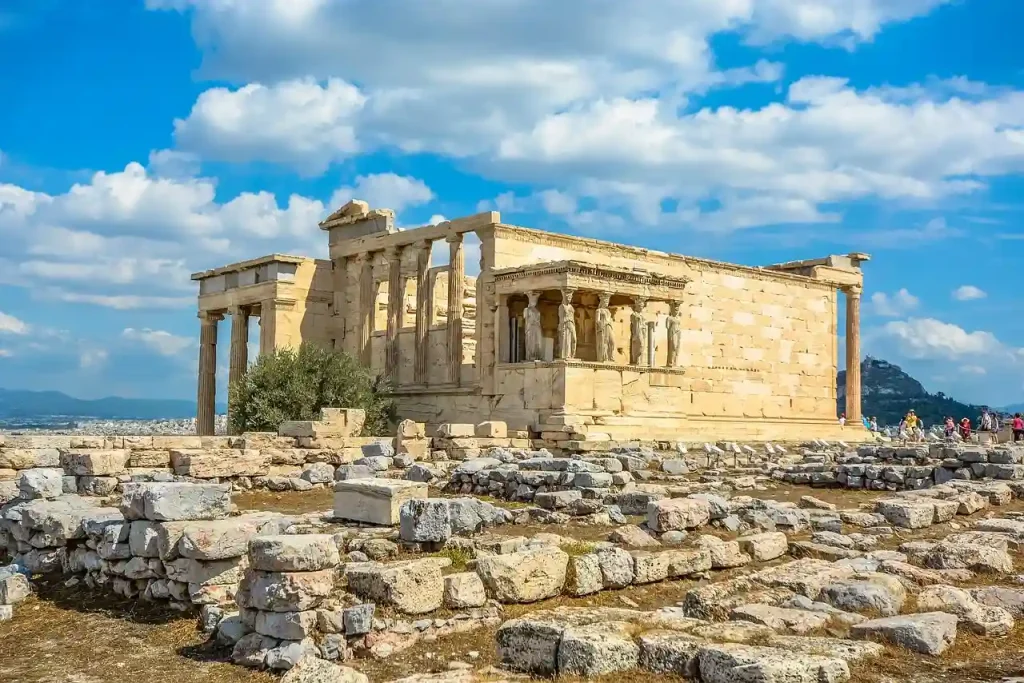
Among the temples of the Acropolis, the most prominent are the Parthenon, the Erechtheion, the Temple of Athena Nike, the Brauroneion, and the Pandroseion. These structures represent the most important buildings on the Acropolis and were primarily erected during the 5th century BC under Pericles’ building program to celebrate Athenian supremacy. Additionally, they housed the city’s most sacred cult statues.
| Temple | Main Function | Historical Context |
|---|---|---|
| Parthenon | Treasury and cult of Athena Parthenos | Built between 447 and 432 BC during the rule of Pericles. |
| Erechtheion | Multiple cults (Athena, Poseidón, Erechtheus) | Built between 421 and 406 BC on the site of previous temples. |
| Temple of Athena Nike | Commemoration of military victory | Erected around 420 BC to celebrate victories against Persia. |
| Brauroneion | Sanctuary of Artemis Brauronia | Founded in the 6th century BC and expanded by Pericles. |
| Pandroseion | Cult of Pandrosus and the sacred olive tree | Space adjacent to the Erechtheion linked to founding myths. |
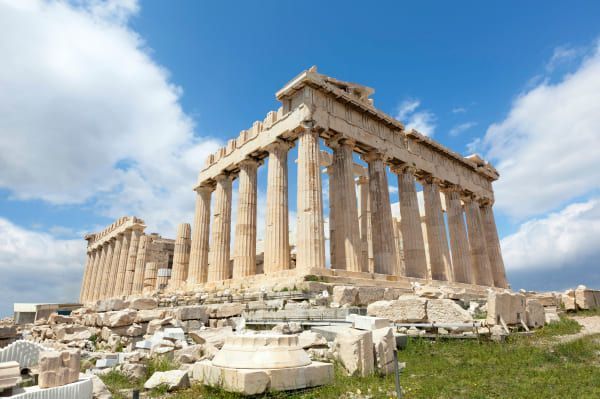
The Parthenon is the largest and most recognized Acropolis building, designed by the architects Ictinus and Callicrates under the supervision of the sculptor Phidias. This main Athenian Acropolis temple was dedicated to Athena Parthenos, the virgin version of the protective goddess of the city. Although the structure is a peripteral Doric temple, it technically functioned as the treasury of the Delian League, guarding the precious metal reserves of Athens.
The statue of Athena resided in its interior, made of gold and ivory (chryselephantine), which reached 12 meters in height. The construction used Pentelic marble almost entirely, with a design that incorporates optical refinements to correct human visual distortions. The Parthenon symbolizes the peak of Athenian democracy and the victory over the Persians, establishing itself as the maximum exponent of Greek classical architecture.
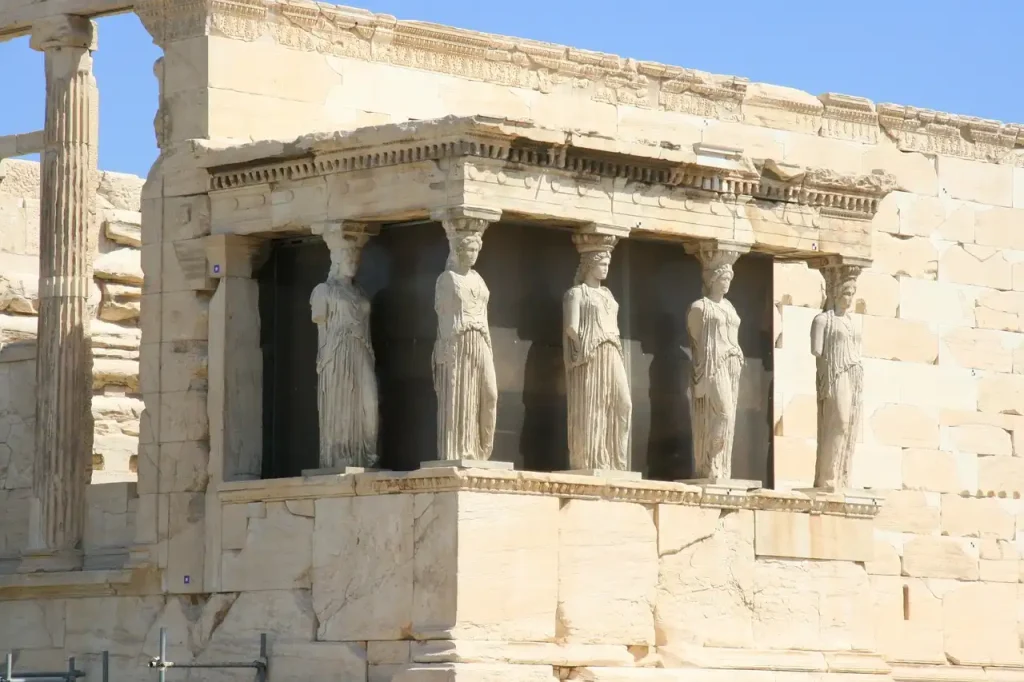
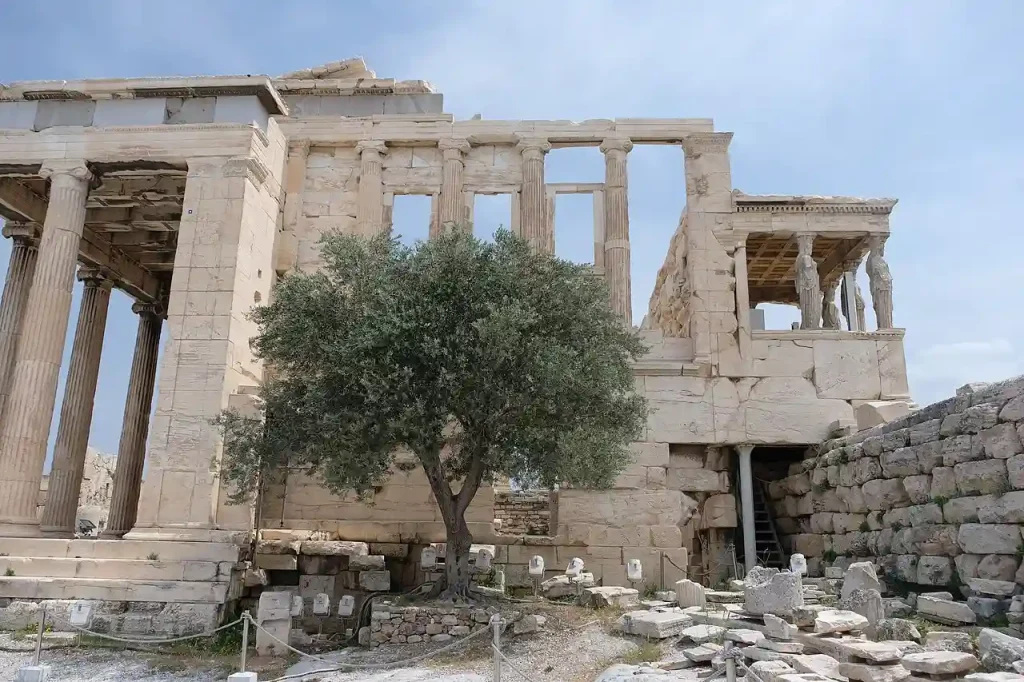
The Erechtheion stands out as the most sacred and complex temple of the Acropolis due to its asymmetric structure and the multiplicity of deities it housed. This Ionic style building is located on the north side of the complex and workers built it to protect the oldest sites of local mythology. The Erechtheion served as a sanctuary for Athena Polias, the protector of the city, as well as Poseidon and the mythical king Erechtheus.
The most distinctive architectural element is the Caryatids, six sculpted female figures that support the entablature of the south porch instead of traditional columns. The interior of the building managed the coexistence of various cults, including the place where Poseidon supposedly struck the rock with his trident. The complexity of its floor plan responds to the need to respect the irregular terrain and the pre-existing religious remains.
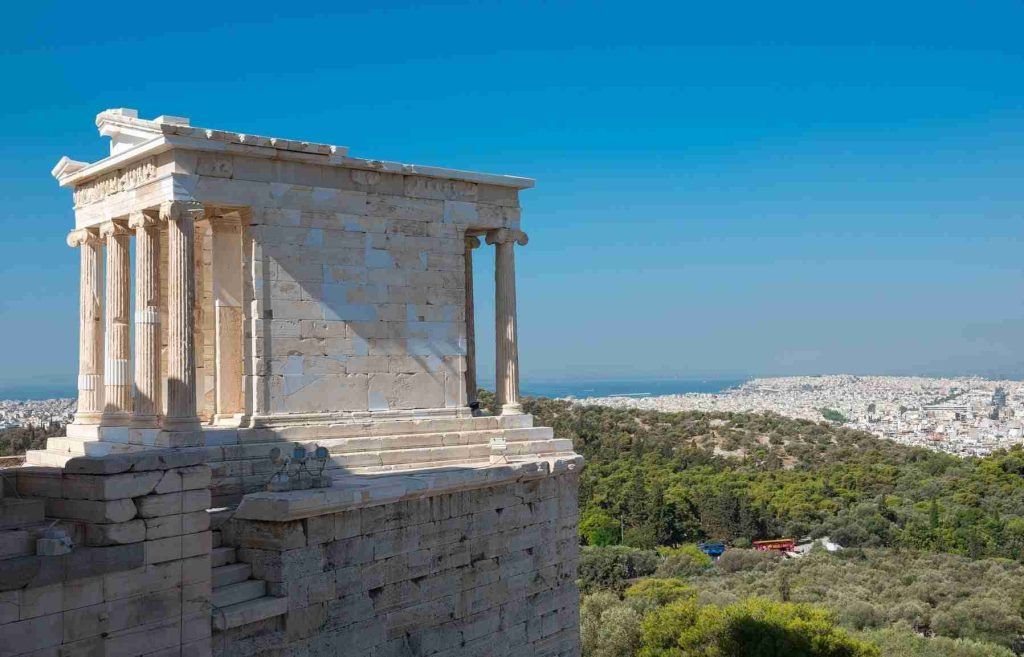
The Temple of Athena Nike is a small-scale Ionic building located on the southwest bastion, right at the edge of the precipice next to the monumental entrance.
As one Reddit user puts it: “It is one of the most elegant buildings on the Acropolis of Athens.” This structure is an amphiprostyle temple, meaning it features four columns on its front facade and four at the rear. The architects designed this space to honor Athena as the bringer of victory, specifically following Athens’ military successes against the Persians.
Unlike other representations of victory (Nike), which usually had wings, the cult statue in this temple lacked them to ensure that victory would never leave the city. The exterior frieze depicts scenes from the Battle of Plataea, highlighting the commemorative nature of the construction. Its location allowed citizens to make offerings of gratitude immediately before entering the main sacred precinct of the citadel.
The Brauroneion functioned as the official sanctuary of Artemis on the Acropolis, acting as an extension of the main sanctuary located in Brauron. Today, few visible remains of this structure exist, which was located between the Propylaea and the Parthenon.
Artemis Brauronia was the protective divinity of women, pregnancy, and childbirth, and therefore the temple received constant offerings of female clothing and textiles.
The floor plan of the building had an “L” shape and featured a stoa or porch with columns that faced the processional way. In this space, Athenian girls participated in specific rituals and festivals before reaching adulthood. The importance of the Brauroneion resided in its social role, linking divine protection with the biological cycles and the stability of the families of the polis.
The Pandroseion is an outdoor sanctuary located immediately to the west of the Erechtheion. This space was dedicated to Pandrosus, daughter of Cecrops, the first mythical king of Athens. The precinct had vital importance for the identity of the city, as the sacred olive tree that the goddess Athena gave to the citizens was located at this exact point.
The sanctuary consisted of a rectangular courtyard surrounded by walls, which also housed the altar of Zeus Herkeios under the olive tree. The physical connection between the Pandroseion and the Erechtheion allowed a fluid circulation of priests and participants in the rites of purification and fertility. Although it is a less imposing structure than the other temples, its symbolic value as the place of the “birth” of Athenian agriculture was fundamental.
The function of the temples of the Acropolis transcended liturgical practice. According to archaeological research, structures such as the Parthenon and the Erechtheion fundamentally operated as storage centers for economic resources and high-value offerings. These buildings housed the public treasury of Athens and the contributions of the allies, functioning as a financial reserve for military or economic crises.
The deposited offerings were not only acts of faith, but tangible assets that demonstrated the wealth and the reach of Athenian influence over the Aegean. For example, the gold that covered the statue of Athena Parthenos was considered a metal reserve that the state could melt in case of extreme national necessity. Therefore, the temples of the Acropolis integrated the divine sphere with the state administration, serving as showcases for citizen prosperity and as security vaults for the material goods of the polis.
In addition to the religious temples, numerous famous structures are found on the Acropolis and its slopes, with functions ranging from administration to art.
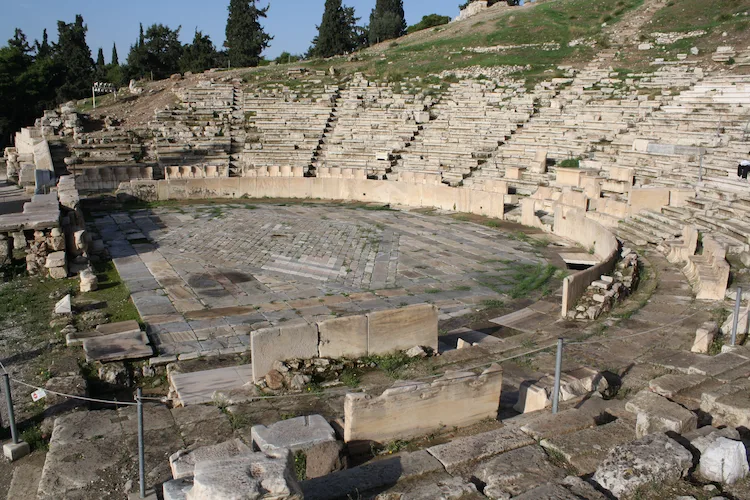
This theatre situated on the south slope was the stage where the most important tragedies and comedies of antiquity premiered. Originally built in wood and later reconstructed in stone and marble, the venue had the capacity to house more than 17,000 spectators. It was the center of the Great Dionysia, religious festivals where theatrical competition served as a tool for civic cohesion.

The wealthy Roman aristocrat Herodes Atticus built this stone theatre in 161 AD in memory of his wife, Aspasia Annia Regilla. Unlike the Theatre of Dionysus, this odeon originally featured a cedar wood roof and served mainly for musical concerts and philosophical recitals. Its three-level facade with Roman arches remains one of the most iconic structures on the south slope.
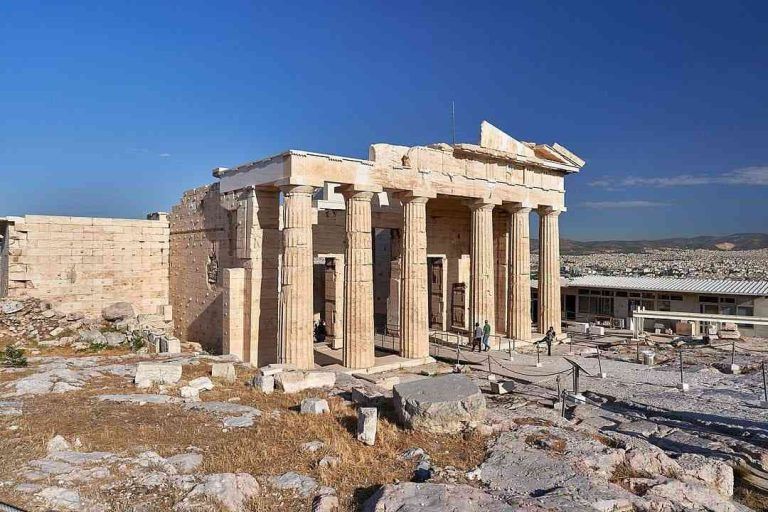
The Propylaea are the monumental entrance to the precinct, designed by the architect Mnesicles under the construction program of Pericles. This structure combined Doric and Ionic columns to create a solemn passage that prepared the visitor for the vision of the Parthenon. Its construction stopped due to the start of the Peloponnesian War, but its design influenced Western architecture permanently.
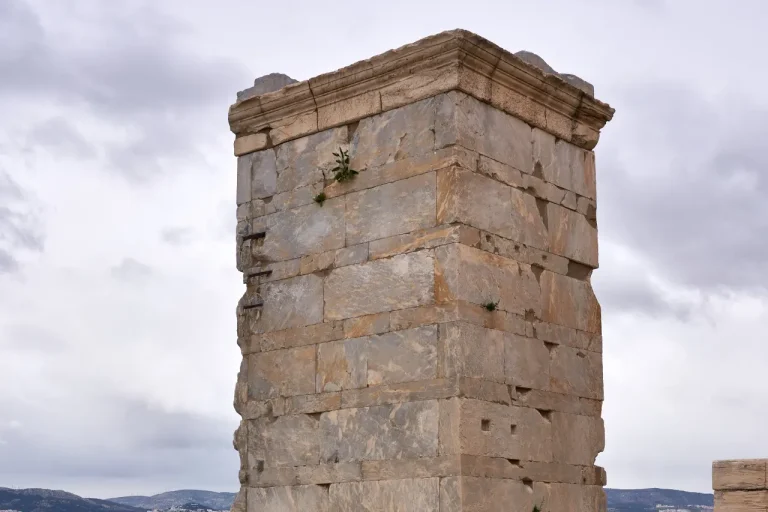
This Hymettian marble pedestal, nearly 9 meters high, stands in front of the Propylaea and workers originally erected it to support a bronze quadriga. In the 1st century BC, the city dedicated it to Marcus Vipsanius Agrippa, general and son-in-law of Emperor Augustus. The upper statue disappeared due to looting and the melting of precious metals during the Middle Ages.
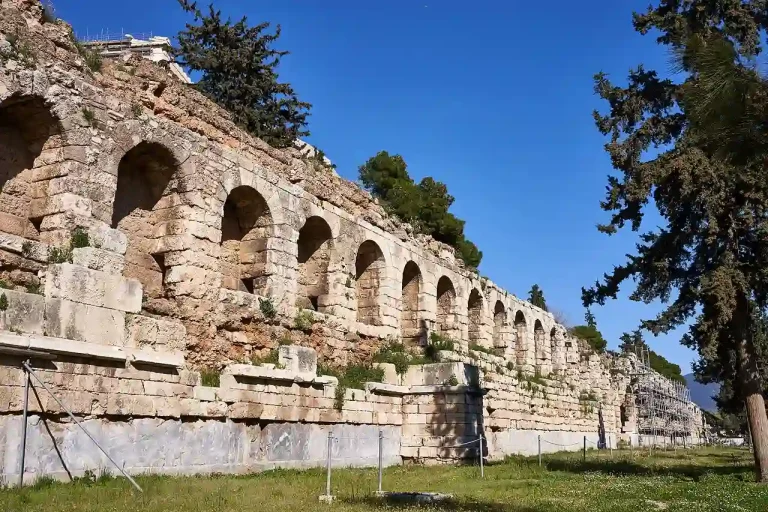
This long, two-story porticoed structure was a gift from King Eumenes II of Pergamon to the city of Athens in the 2nd century BC. The stoa extends along the south slope, strategically connecting the Theatre of Dionysus with the Odeon of Herodes Atticus. Its main function was to provide covered shelter for the theatre spectators in case of rain or intense sun.
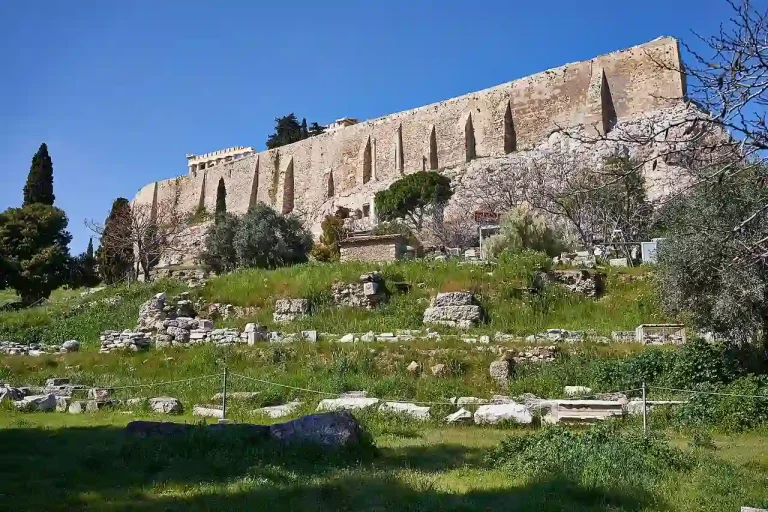
The Odeon of Pericles was the first roofed building built in Athens specifically for the performance of musical competitions and poetic recitals. Located east of the Theatre of Dionysus, its architectural design was unique, with a rectangular floor plan and a pyramidal roof. This building symbolized the cultural and military victory of Athens, providing a superior acoustic space.
Other ancient buildings, whose locations have been approximately identified through archaeological research, include:
Located in the north wing of the Propylaea, the Pinacotheca functioned as one of the first documented public art galleries in history. This space was dedicated to the exhibition of paintings on wooden panels, which represented mythological scenes and historical feats of Athens. Visitors could rest in its interior and admire the artworks while waiting to enter the main sanctuary.
The Arrephorion was a small building that served as a residence for the Arrephoroi, four girls from the Athenian nobility chosen annually to serve the goddess Athena. Was located approximately to the northwest of the Parthenon, in the upper area of the Acropolis, and slightly to the west of the Erechtheion. The building featured a courtyard where the girls lived in partial seclusion.
The Chalcotheca was a large storage building located on the south side of the Acropolis, right next to the southern wall, near the entrance to the Propylaea, intended to guard bronze objects, weapons, and other metallic treasures. Its name derives from the combination of the Greek words khalkos (bronze) and theke (repository), reflecting its function as a security warehouse. It was a rectangular structure with a porch that protected state inventories of ceremonial weaponry.
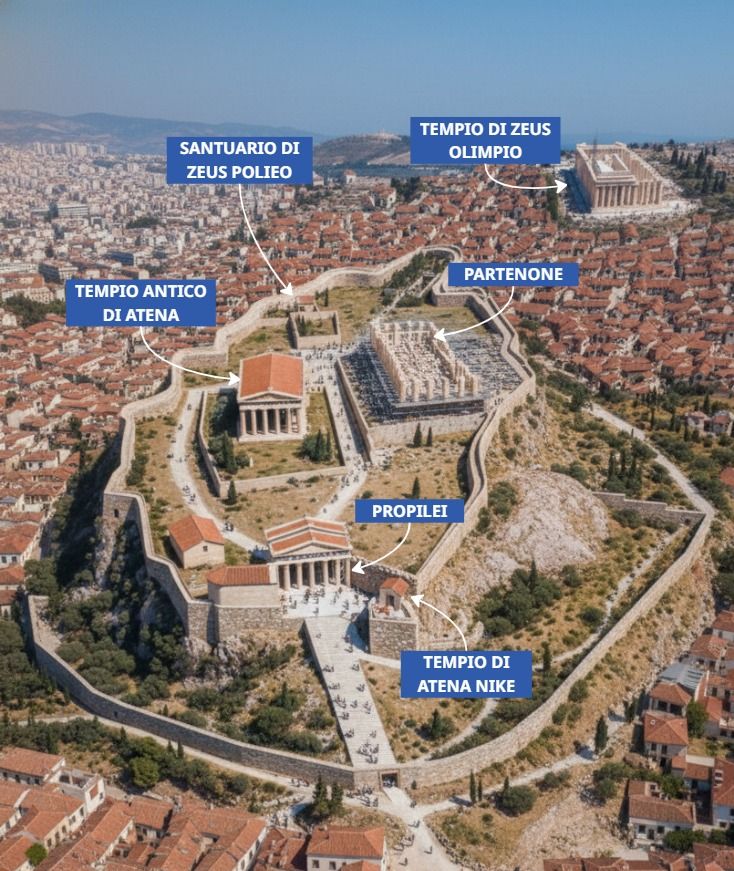
As previously mentioned, the Parthenon is the most famous temple due to its proportions, its history as a treasury, and its status as a global symbol of classical architecture and democracy.
Several buildings such as the Arrephorion, the Chalcotheca, and the Odeon of Pericles have almost completely disappeared, with only their foundations or descriptions in ancient texts remaining today.
The Acropolis is the result of several “waves” of construction driven by political leaders, foreign kings, and millionaires. The tyrants Pisistratus and Cimon carried out the first major interventions. However, the definitive impulse came from Pericles, who directed the monumental reconstruction in the 5th century BC.
Later, leaders like Lycurgus reformed spaces like the Theatre of Dionysus. During the Hellenistic and Roman periods, King Eumenes II of Pergamon and the Roman general Agrippa contributed significantly. Finally, Herodes Atticus built the odeon that bears his name.
The Temple of Athena Nike is the smallest temple of the Acropolis: it measures approximately 8.27 meters long and 5.44 meters wide, while its columns reach a height of barely 4 meters. It was designed as an Ionic architectural jewel in a small space next to the entrance.


