Difference between the Acropolis and the Parthenon
Explore the history and details of the Parthenon in Athens, one of ancient Greece's most important monuments. Below, we break down the difference between the Parthenon and the Acropolis and share essential tips for an unforgettable visit.
Is Parthenon the same as Acropolis?
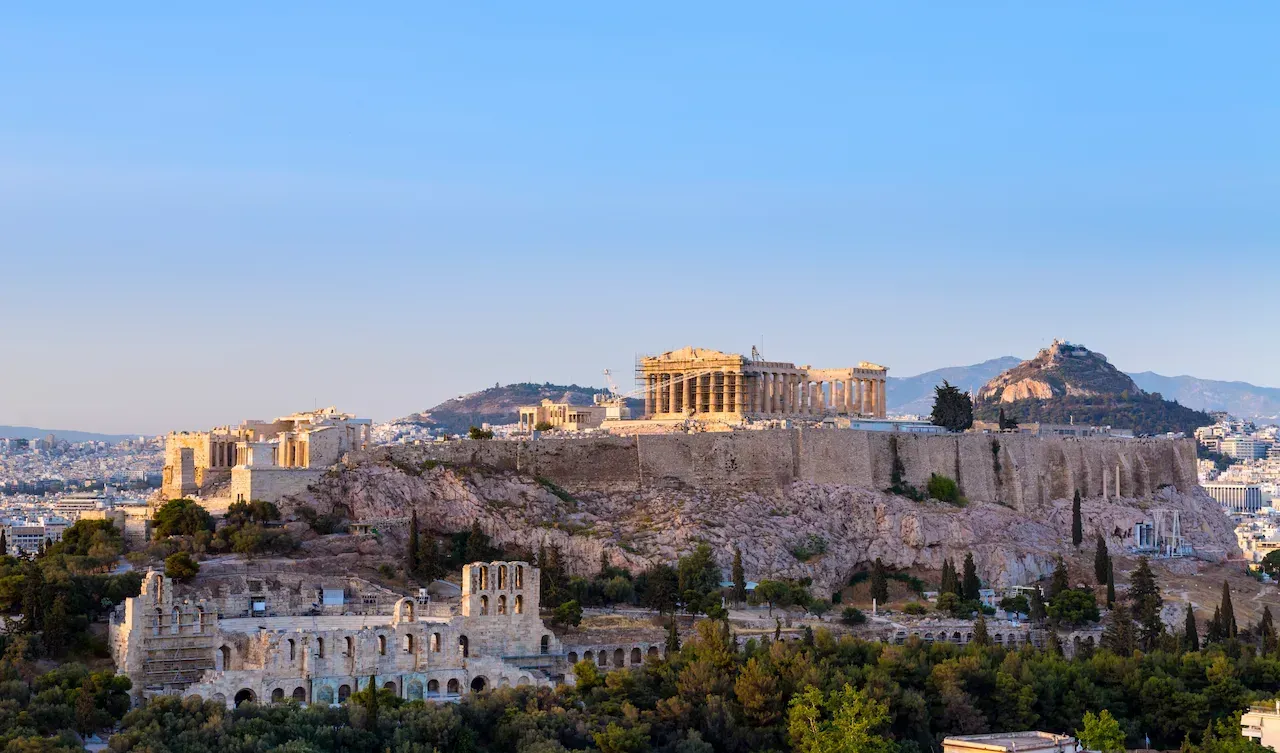
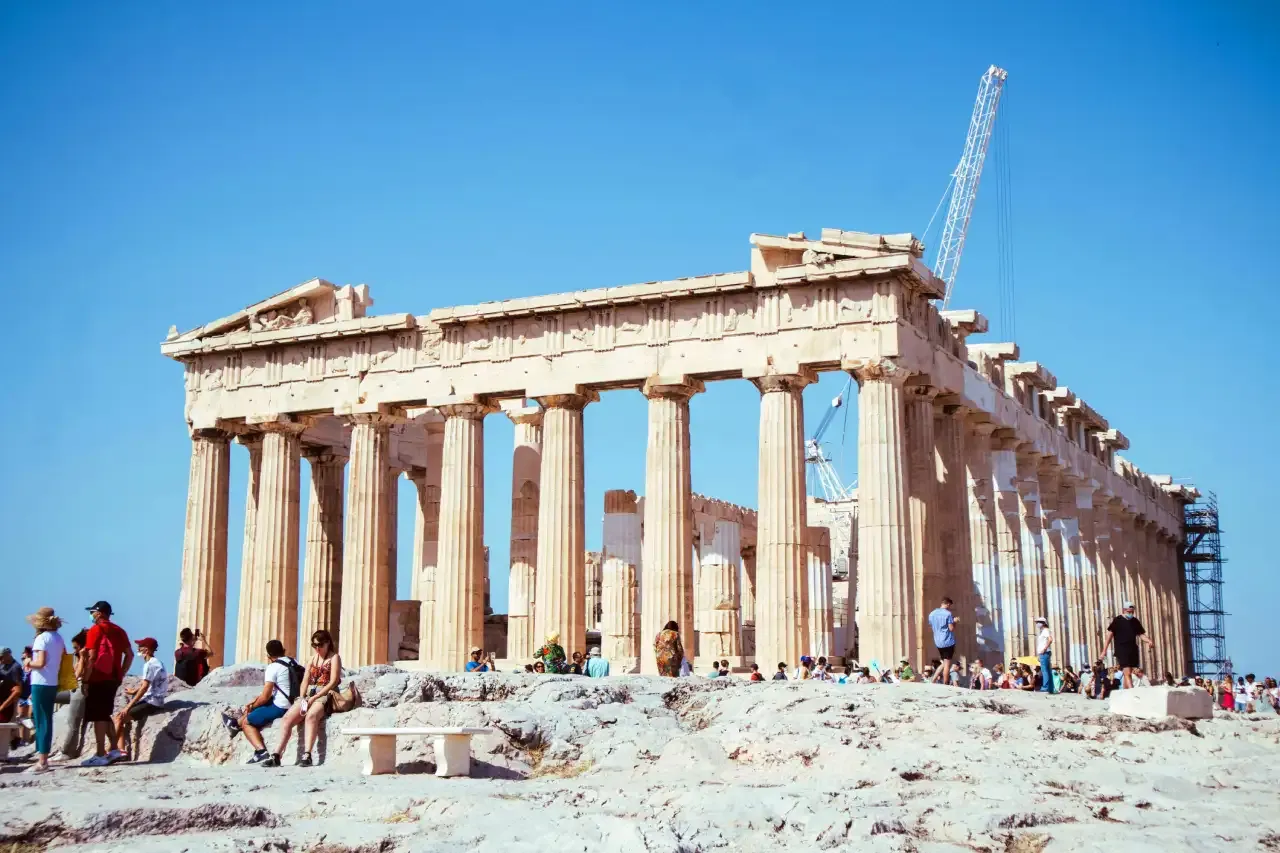
The Parthenon is the largest, central, and most famous temple within that Acropolis. It was built, as we will elaborate on in the following lines, in honor of the goddess Athena, and it is the quintessential symbol of classical Greek architecture and Athenian democracy. The Acropolis is the sacred site and the plateau where several notable temples and structures stand. When you climb the Acropolis, you are not only visiting the Parthenon, but an architectural ensemble that includes other must-sees.
In short, the Acropolis is the site, the sacred enclosure on top of the hill, and the Parthenon is the temple located inside it.
Where is the Parthenon?
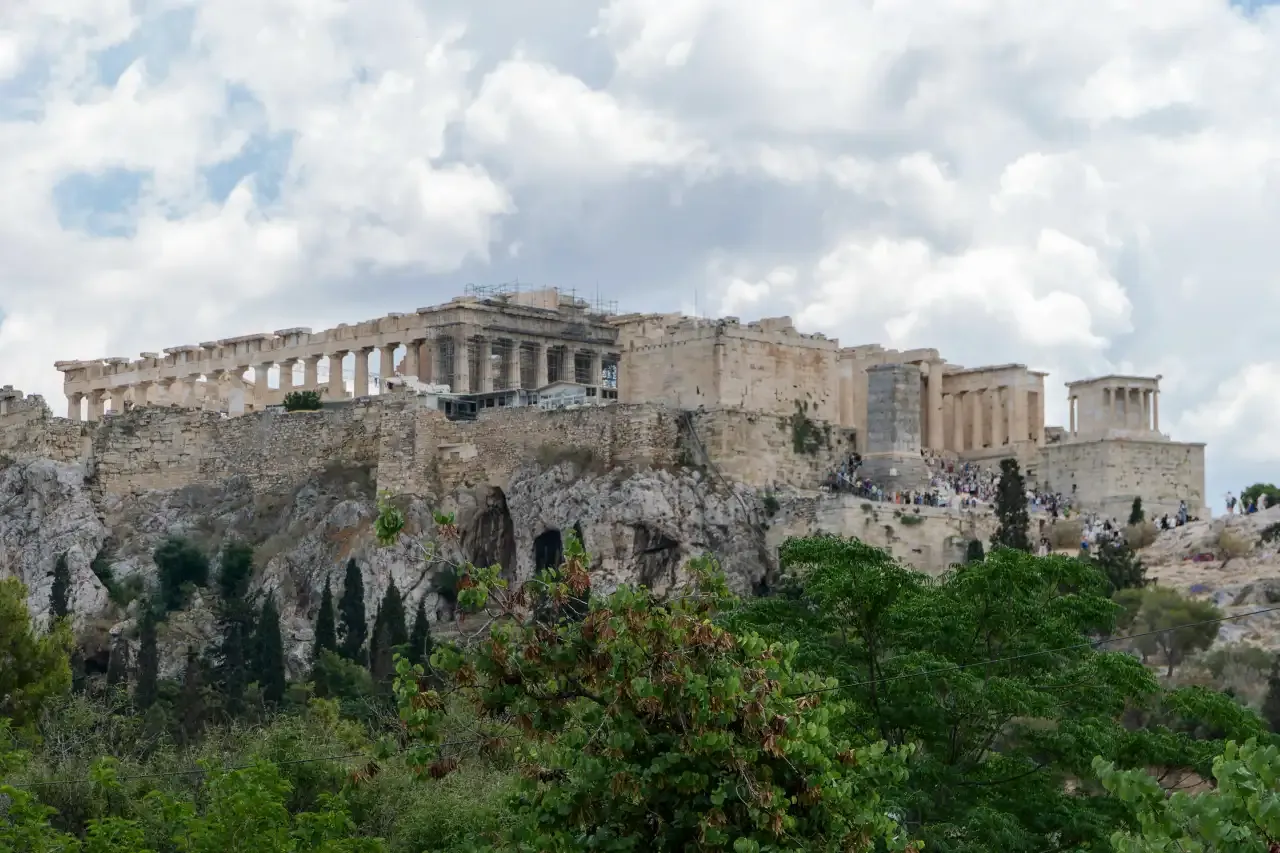
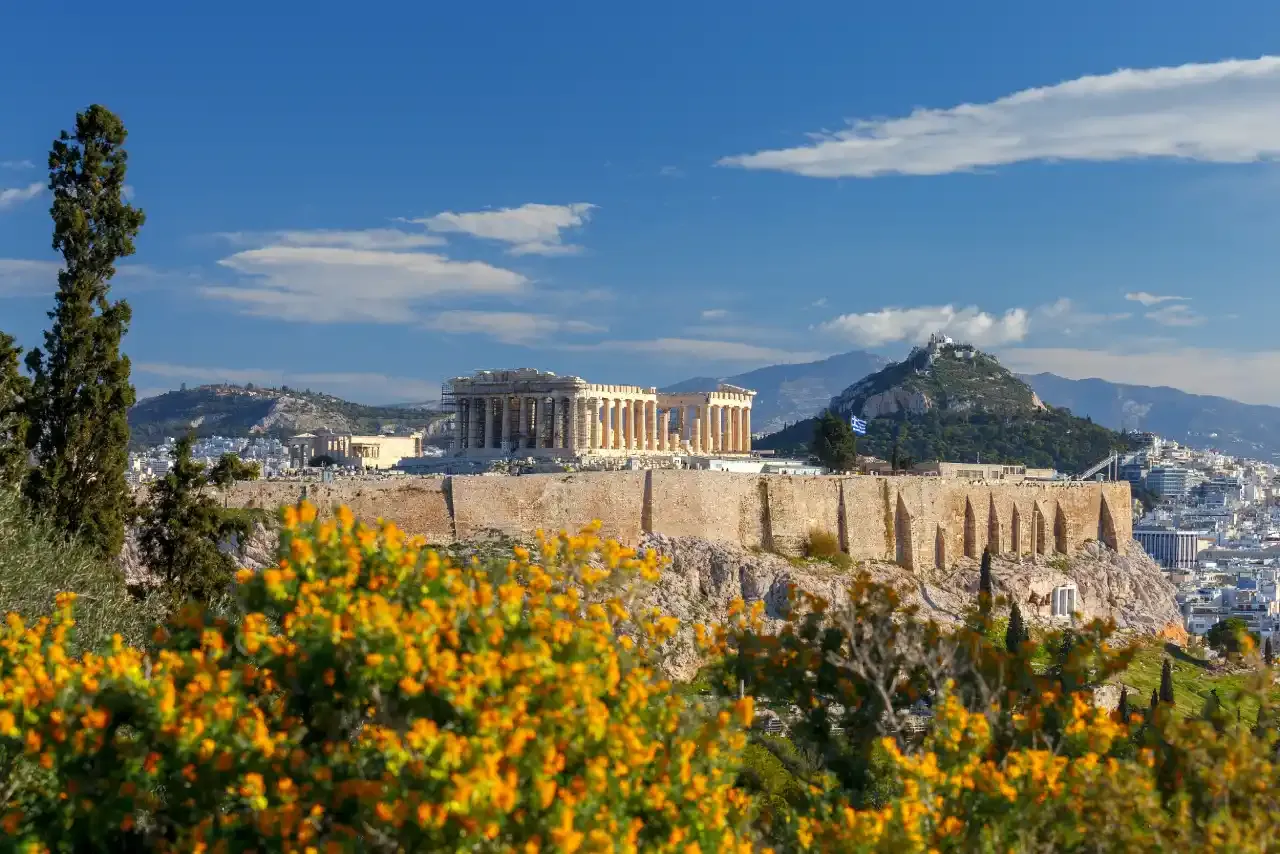
The Parthenon is located in Athens, Greece, standing at the highest point of the Acropolis. This world-famous ancient temple sits on the south side of the hill’s flat summit, positioned right in the historic heart of the Greek capital.
Visible from almost every corner of downtown Athens, its central location makes it highly accessible to travelers. Visitors can reach the site by taking a scenic uphill walk from the historic Plaka neighborhood or via nearby metro stations like Acropoli. This prominent, elevated positioning ensures the monument remains the defining feature of the city's modern skyline.
Facts about the Parthenon
Facts about the Parthenon
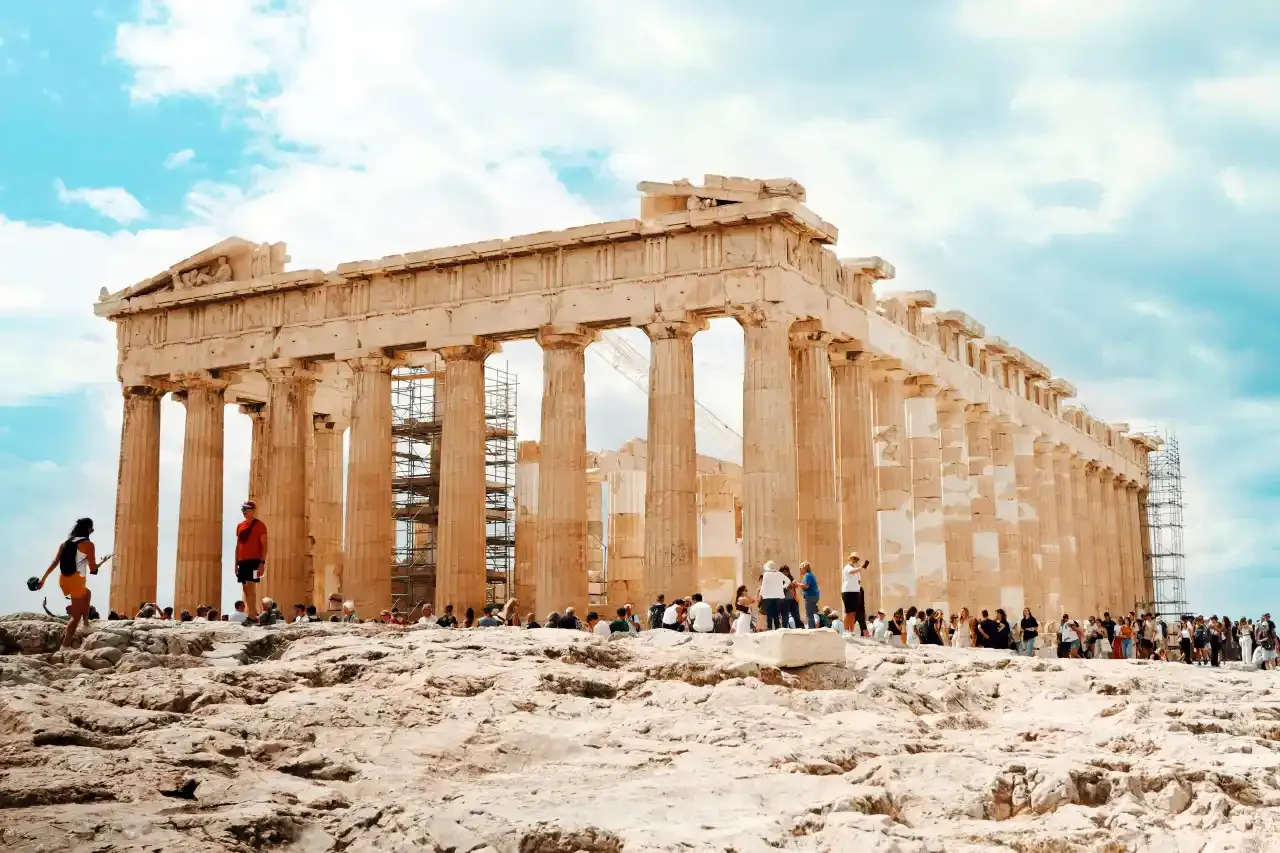
One of the most fascinating facts about the Parthenon is its use of sophisticated optical illusions; its columns and floor are slightly curved to appear perfectly straight to the human eye. Despite suffering severe damage over centuries from explosions and looting, it remains a global symbol of democracy and classical beauty.
Today, extensive restoration efforts continue to preserve its marble structure and historical integrity for future generations.
Plan your visit to the Parthenon
Opening hours
Since the Parthenon is the main structure located at the top of the Acropolis, the visiting hours are the same as those of the entire site. The Acropolis opens at 8:00 AM, with the closing time varying by season: in summer (April to October), it usually closes at 8:00 PM, while in winter (November to March) the closing time is earlier, at 5:00 PM.
It is important to remember that access is stopped half an hour before the closing time.
Is it accessible to visitors with reduced mobility?
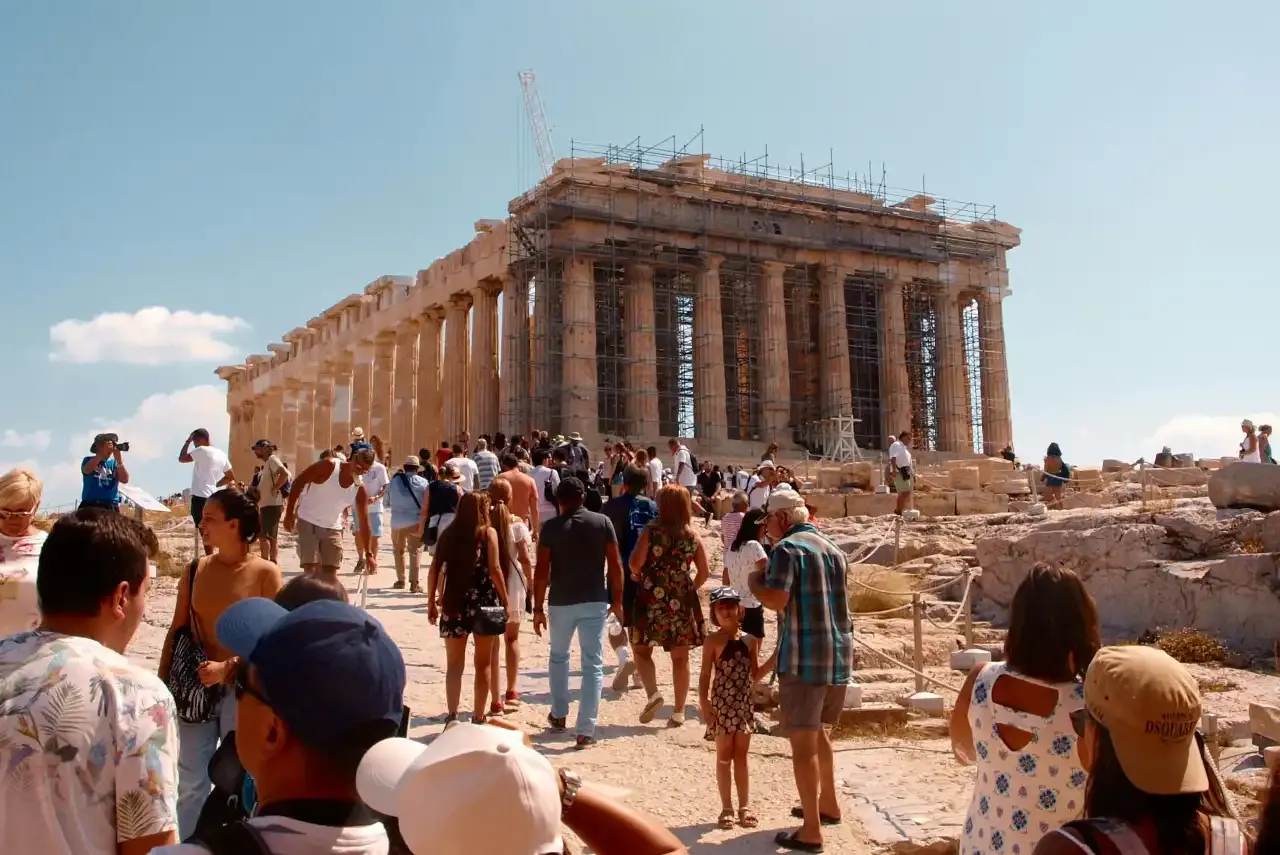
The Acropolis, being a rocky hill with uneven terrain and ancient stairs, is not easy to navigate. However, measures have been implemented to improve accessibility, especially for people with reduced mobility.
On the northwest side of the hill, there is an elevator that is specifically designed for wheelchair visitors, people with walking difficulties, and parents with baby strollers (although its main use is for people with disabilities or the elderly).
However, you should keep in mind that, although the elevator facilitates the ascent to the plateau, once you are up there, the terrain around the Parthenon is still uneven, with ancient stones and, at times, slippery surfaces, which can make circulation a bit complicated. Despite this, the areas surrounding the Parthenon and other main temples are, for the most part, covered by compacted dirt paths or walkways that make access easier.
Our recommendation for the elderly or those with reduced mobility is to wear comfortable, non-slip footwear, and if you need the elevator, contact the site staff in advance to ensure its availability and proper functioning.
Book in advance

History of the Parthenon
The history of the Acropolis and the Parthenon began long before its construction, which is why, to understand its magnitude, we have to travel to the Golden Age of Athens. The construction of the Parthenon began in 447 BC and was completed in 438 BC, although the sculptural decoration continued until 432 BC. It was the most sublime form of Greek art and architecture.
And who built it? The design and supervision were carried out by the architects Ictinus and Callicrates, while the sculptor Phidias was responsible for the artistic direction and the creation of the impressive sculptures.
Photo: "Depiction of Ictinus and Callicrates on the facade of the historical building of the University of Athens" by George E. Koronaios.
To whom was the Parthenon dedicated?
To whom was the Parthenon dedicated?
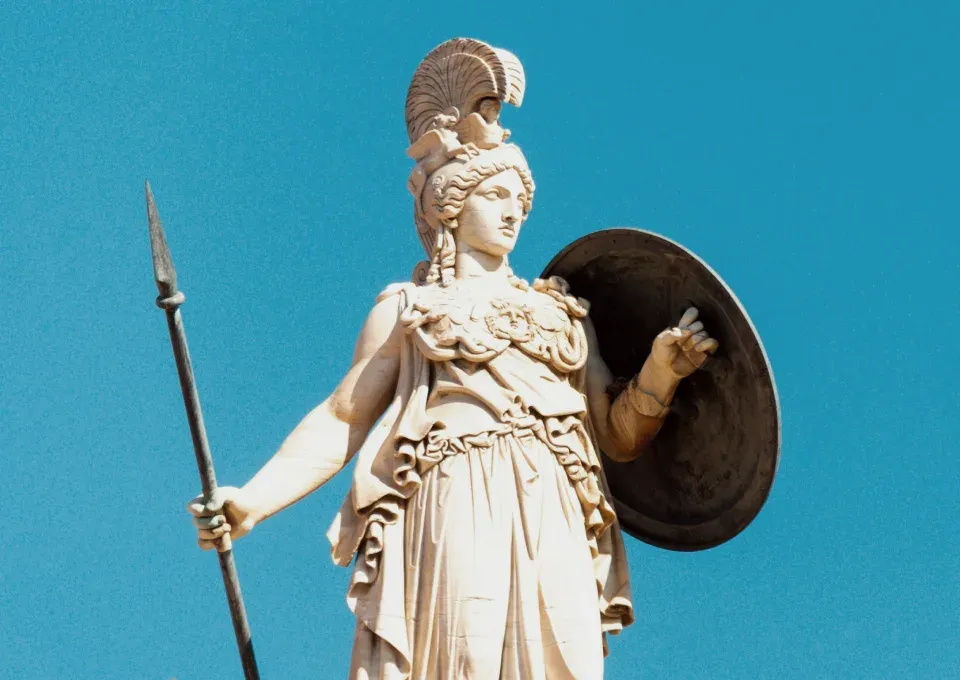
This is a question that is often confused, but the answer is clear: the Parthenon was dedicated to the goddess Athena, specifically to the invocation of Athena Parthenos, the protector of the city, hence its name, which means “the chamber of the Maiden.” Therefore, the goddess also known as the goddess of wisdom, strategic warfare, and crafts was the one to whom the Parthenon was dedicated.
Transformations and decay
Throughout the centuries, the Parthenon, as a building, has seen many changes in use. After Antiquity, around the 6th century AD, it was transformed into a Christian church dedicated to the Virgin Mary. Later, after the Ottoman conquest in 1458, it became a mosque, and even in 1687, during the Venetian siege, it was used as a gunpowder magazine (to store gunpowder).
The disaster and the Elgin Marbles
It was precisely its use as a gunpowder magazine that led to its greatest devastation. During a Venetian siege in 1687, a projectile struck the temple, causing a catastrophic explosion that left much of it in ruins.
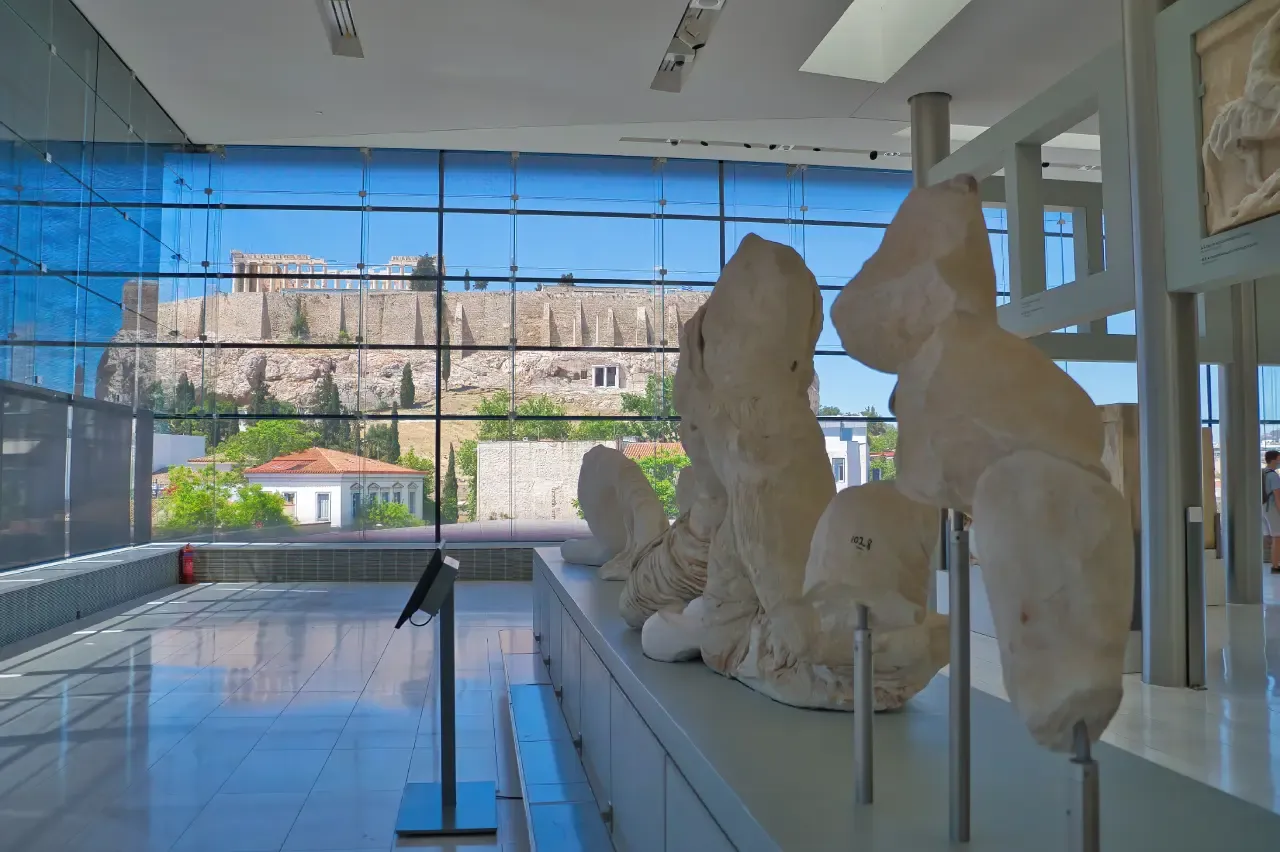
Subsequently, at the beginning of the 19th century, Thomas Bruce, 7th Earl of Elgin and British ambassador to the Ottoman Empire, removed and transferred a significant part of the Parthenon’s sculptures to Great Britain, including sections of the frieze, several metopes, and some pieces of the pediments. These sculptures, known as the Elgin Marbles or Parthenon Marbles, are now housed in the British Museum in London and are the subject of constant international debate regarding their possible repatriation to Greece. Therefore, if you wonder where the remains of the Parthenon (its sculptures) are located, the answer is divided between the Acropolis Museum in Athens and the British Museum.
What is the architecture based on the Parthenon?
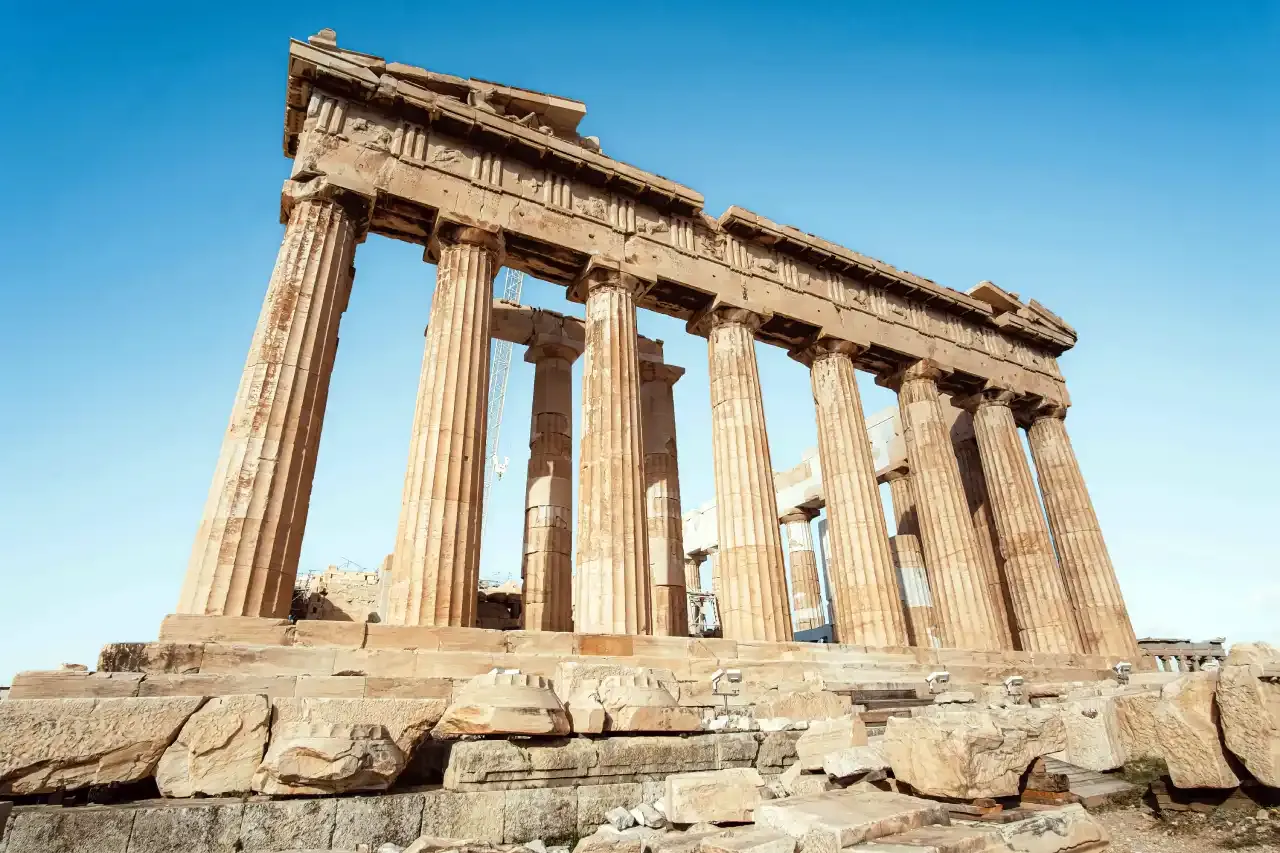
What is the architecture based on the Parthenon?
The Parthenon represents the pinnacle of Doric architecture, defined by its rectangular floor plan and robust columns. Beyond its imposing symmetry, the temple’s genius lies in sophisticated optical corrections. To counteract visual distortions, architects implemented entasis (a slight swelling of columns) and a subtle upward curvature of the stylobate to prevent the structure from appearing to sag. Additionally, corner columns were thickened to maintain visual uniformity against the bright sky.
This masterpiece was originally adorned with mythological reliefs and the famous Panathenaic frieze. Today, the monument undergoes perpetual restoration to combat environmental damage. While scaffolding is a common sight, major sections are expected to be unveiled by 2026, preserving this testament to Greek ingenuity for future generations.
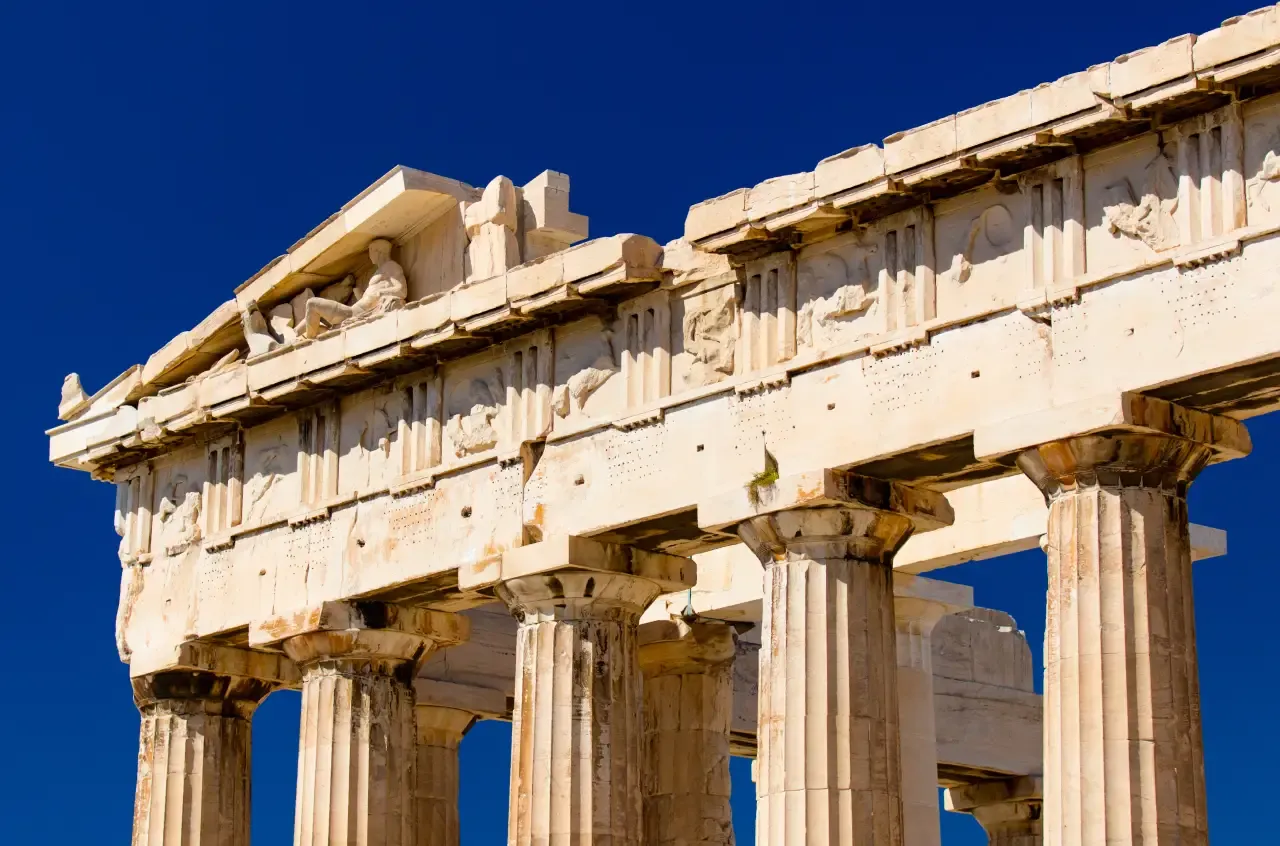
Highlights of the architecture of the Parthenon
The Parthenon’s sculptural program reflects Greek excellence through three distinct elements:
- The 92 metopes depict legendary battles—such as the Centauromachy and the Trojan War—symbolizing the triumph of civilization over chaos.
- Higher up, the pediments feature monumental sculptures: the East portrays Athena’s miraculous birth, while the West captures her contest against Poseidon for Athens' patronage.
- The frieze breaks from mythology to illustrate the Panathenaic Procession. This continuous relief honors Athena by depicting Athenian citizens, musicians, and priests in exquisite detail.
Directed by Phidias, these masterpieces combine dynamic movement with cultural values, immortalizing both divine legends and the collective spirit of the city-state within the temple’s iconic Doric structure.